INTELLIGENCE BRIEFINGS

NERVOSYS BLOG

Research updates, technical deep-dives, and announcements from the frontier of embodied AI.

01

LATEST POSTS

Introducing HyperMachine: an agentic hypervisor for autonomous AI systems

Introducing HyperMachine: an agentic hypervisor for autonomous AI systems

Listen to this articleYour browser does not support the audio element. AI agents are starting to run real workloads — building software, executing tools, driving long-horizon tasks — and every one of those workloads needs somewhere safe to run. The honest answer today is a tangle of containers, cloud VMs, and shell scripts glued together with brittle CLI scraping. None of it was designed for an agent that wants to discover what it can do, reserve a GPU, spawn a sandbox, and clean up after i

Jun 5, 20265 min read
Introducing AgenticPDF: a PDF library built for AI agents

Introducing AgenticPDF: a PDF library built for AI agents

Listen to this articleYour browser does not support the audio element. PDFs are everywhere an AI agent needs to look — contracts, papers, invoices, manuals — and almost none of them were built to be read by a machine. A single document can run to hundreds of pages, the text arrives as a soup of positioned glyphs rather than sentences, and most libraries insist on loading the whole thing into memory before they will tell you anything. For an agent paying by the token and the millisecond, tha

Jun 4, 20266 min read
AetherShell 1.5 and agentic-eval: making “the shell for AI agents” a measured claim

AetherShell 1.5 and agentic-eval: making “the shell for AI agents” a measured claim

Every shell that wants to work with AI agents claims it was built for them. We decided to stop claiming it and start measuring it. So this release does two things: it introduces a brand-new open-source tool, agentic-eval, that scores any program for how well it works with AI agents — and it ships AetherShell 1.5, which uses that tool to harden and benchmark itself. On a zero-to-ten score across four areas, AetherShell scores 9.6. Nushell scores 2.3, PowerShell 2.2, and the traditional Bash, Zsh

Jun 3, 20264 min read
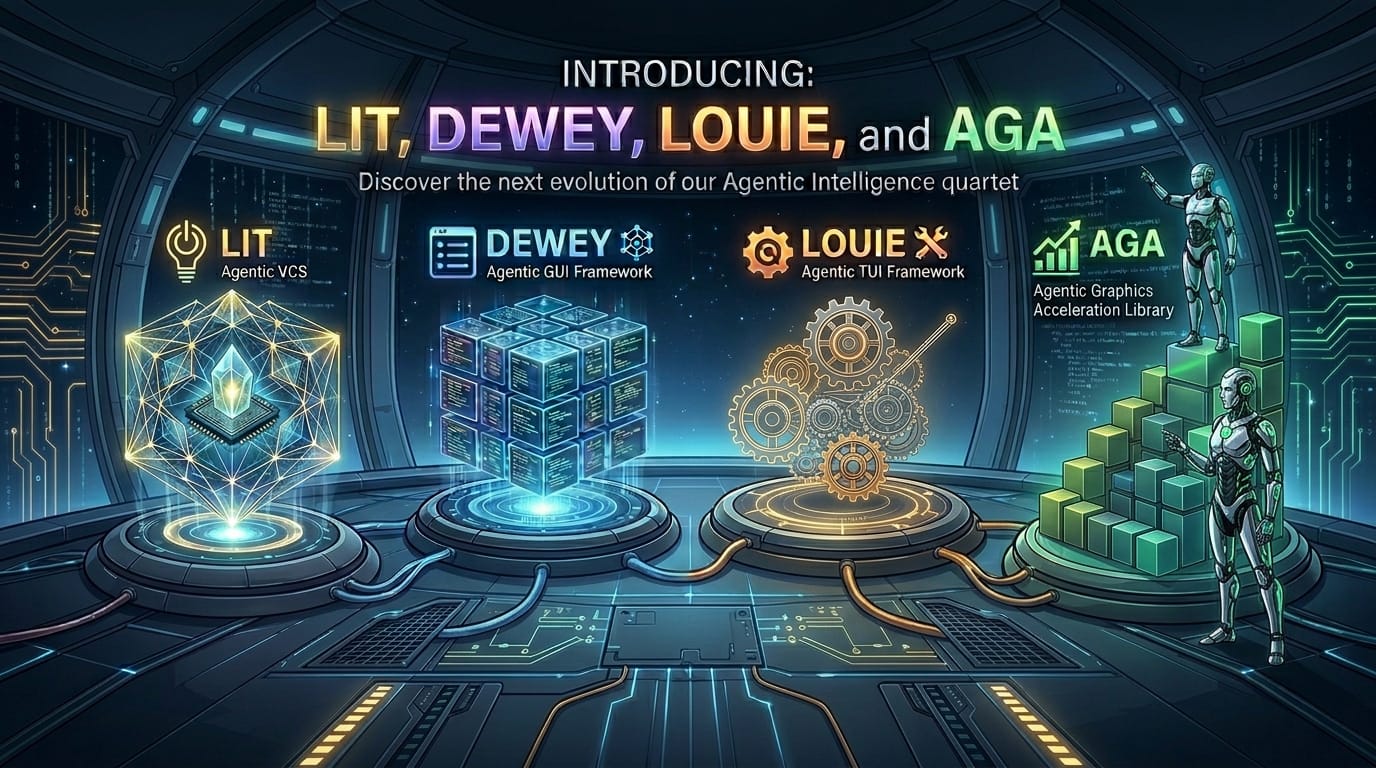
Introducing Lit, Louie, and Dewey

Introducing Lit, Louie, and Dewey

Three new open-source, agentic-first Rust tools from NERVOSYS: Lit (version control), Louie (TUI framework), and Dewey (GUI framework). Structured data by default, a machine-readable ontology for agent discovery, and hardened agent-facing entry points.

Jun 1, 20263 min read
AgenticBlockTransfer — A Better dd for AI Agents and Humans

AgenticBlockTransfer — A Better dd for AI Agents and Humans

Today we are releasing AgenticBlockTransfer (abt), an open-source cross-platform disk imaging tool built in Rust that reads, writes, verifies, hashes, and formats block devices via CLI, TUI, and GUI interfaces — with native support for AI agent orchestration through JSON-LD ontology, OpenAPI, and the Model Context Protocol (MCP). abt is both an agentic-first CLI successor to dd and a human-first GUI/TUI successor to balenaEtcher, Ventoy, Rufus, Fedora Media Writer, and rpi-imager. Simple. Relia

Mar 3, 20265 min read
Introducing AetherShell, Simon, and Chasm

Introducing AetherShell, Simon, and Chasm

Today, we are excited to announce three new open-source tools from NERVOSYS, each built in Rust and designed from the ground up for the age of AI agents. Together they form a powerful triad: AetherShell, Simon, and Chasm. AetherShell — The AI-Native Command Line Traditional shells were designed for humans typing text commands. AetherShell reimagines the command line for a world where AI agents are first-class participants. AI agents today are forced to interact with shells designed decades a

Feb 16, 20263 min read
Interview: Coffee with a Researcher @ ICRA 2022

Interview: Coffee with a Researcher @ ICRA 2022

Below is a transcript of my interview with Ahalya Ravendran of the Australian Centre for Field Robotics at the University of Sydney, conducted as part of the Coffee with a Researcher series for the IEEE International Conference on Robotics and Automation (ICRA 2022): How can robots learn to interact with and reason about themselves and the world without an intuitive feel for either? Communication is at the heart of biological and robotic systems. Inspired by control theory, information theory,

Jul 5, 20222 min read
Coming soon

Coming soon

This is Nervosys Blog, the official blog of Nervosys that is just getting started. Things will be up and running shortly, but you can subscribe in the meantime if you'd like to stay up-to-date and receive emails when new content is published!

Jul 3, 20220 min read